


.png)
.png)


© 2025 PriceIntelGuru. All Rights Reserved
If you manage pricing for a grocery brand or FMCG/CPG manufacturer, you already know how fast things move. A competitor drops a price on a staple household product; a retailer runs a flash promotion, or a new private-label SKU undercuts you in a key channel, and before your team can even pull out a report, the damage is done. Manual price tracking, spreadsheets, and weekly data pulls simply don't cut it anymore. What the market demands in 2026 is real-time visibility, smart automation, and the ability to act before the window closes.
This post breaks down what effective AI price monitoring software for FMCG/CPG grocery looks like, which capabilities matter most, and how the right software turns pricing data into a genuine competitive advantage.
Why Is Price Monitoring So Difficult in FMCG/CPG and Grocery?
Grocery and FMCG/CPG products are the most price-sensitive items across all retail markets. Consumers tend to compare prices across three types of retailers: supermarket chains, online marketplaces, and discount stores. A single price difference of a few cents on a household staple can be enough to shift basket behavior.
The challenge for brands and retailers extends beyond volume, as they need to manage their operations faster. A mid-sized grocery retailer might stock thousands of SKUs, with prices changing across dozens of competitors and channels multiple times per week. The combination of promotions with seasonal pricing, together with regional price differences and multi-channel dynamics, creates a data environment which exceeds human processing capabilities. Add in private-label competition, the growing influence of marketplace pricing, and the complexity of compounds is growing fast.
The result is that most FMCG/CPG and grocery teams are perpetually behind. They're making pricing decisions on data that is days old, relying on partial views of the competitive landscape, and leaving significant margin on the table as a result.
Comparing FMCG/CPG Pricing Tools:
What Should You Actually Look for in FMCG/CPG Pricing Software?
Not all grocery price monitoring tools are built for the scale and precision that FMCG/CPG requires. A few key capabilities separate genuinely useful platforms from those that look good in a demo but underdeliver in practice.
Accurate product matching at scale is the foundation of everything. In grocery and FMCG/CPG, the same product might be listed under dozens of different descriptions, pack sizes, and SKU codes across retailers and marketplaces. Without highly accurate product matching, the pricing data you receive is riddled with false comparisons. PriceIntelGuru's AI-powered product matching delivers 99% accuracy across multi-channel FMCG product sets, which means the insights you act on are reliable.
Real-time competitive monitoring is the second non-negotiable. If your pricing data is 48 or 72 hours old, you're already responding to yesterday's market. Effective retail pricing for FMCG/CPG demands live price feeds from competitors' websites, supermarket chains, online grocery platforms, and marketplaces.
The complete picture of supermarket pricing analysis emerges from two components: pricing analytics and trend forecasting. The current pricing information requires more than a simple view, as you must analyze competitor price movements, identify pricing pressure points across product categories, and track promotional activities that create market weaknesses.
How Does AI Price Monitoring Actually Work for Grocery Retailers?
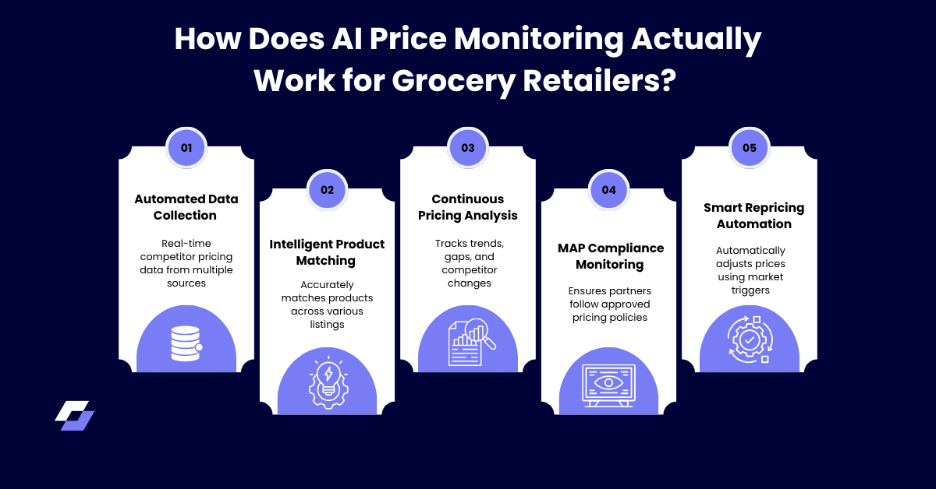
1. Automated Data Collection:
AI-powered price monitoring gathers data from competitor websites, supermarket digital shelves, marketplace listings, and Google Shopping results on a scheduled cadence, often in real time or near-real time.
2. Intelligent Product Matching:
The AI engine identifies and matches equivalent products across multiple listings, removes irrelevant variations, and creates clean, structured pricing data that reflects the real competitive landscape.
3. Continuous Pricing Analysis:
Advanced analytics highlights price gaps, tracks pricing trends, and sends alerts whenever competitors make significant pricing changes.
4. MAP Compliance Monitoring:
For FMCG/CPG brands, AI price monitoring helps ensure that retail partners and distributors adhere to agreed pricing floors, protecting brand value and market positioning.
5. Smart Repricing Automation:
Pricing updates can be automated using rules and competitive triggers, helping grocery retailers stay competitive without constant manual intervention.
What Makes Great Price Intelligence Tools Stand Out
The grocery and FMCG/CPG industries require advanced competitor pricing solutions that go beyond basic competitor price tracking. Effective competitor pricing FMCG/CPG solutions must deliver accurate data, scalable infrastructure, and actionable insights that support enterprise decision-making. Many tools exist for basic operations and small SKU inventories, but only a few tools are designed to manage complex operations with high product volumes.
The real challenge appears at enterprise scale, multi-country, multi-channel environments where product matching accuracy is essential, and the data pipeline must be reliable enough to power automated pricing decisions. The situations demand performance, precision, and operational adaptability.
The biggest gaps usually appear in three key areas. First, product matching. Standard matching logic may work for electronics or apparel, but FMCG/CPG requires deeper intelligence to identify pack sizes, regional variations, and private-label equivalents. Second, global coverage. Strong supermarket pricing analytics depends on data across multiple countries, retailers, and store formats. Third, integration depth. A pricing intelligence platform must seamlessly connect with internal systems via APIs, dashboards, or custom workflows.
PriceIntelGuru was built to solve these exact challenges with enterprise-grade infrastructure, coverage across 50+ countries, and flexible delivery through SaaS, DaaS, and API. For brands that need dependable competitor pricing, FMCG/CPG insights, and scalable supermarket pricing analytics, PriceIntelGuru delivers the precision and reach required for modern enterprise pricing strategies.
How PriceIntelGuru Addresses the Specific Needs of FMCG and Grocery Teams
PriceIntelGuru's platform was designed with the complexity of large-scale retail and FMCG/CPG in mind. The core pricing intelligence capability tracks competitor prices, stock levels, promotional activity, and historical trends across competitor websites, marketplaces, and Google Shopping, giving FMCG/CPG teams a complete picture of the competitive environment in one place.
The Compliance Monitoring module addresses the ongoing problem of MAP enforcement that brands must address. Monitoring prices across multiple eCommerce platforms and distributor websites becomes impossible when dealing with large volumes of data. The system performs automated operations which identify contract violations as they occur, allowing brand teams to respond without waiting several weeks to discover issues.
The Product Intelligence module establishes a new level of catalog assessment, enabling FMCG/CPG teams to discover untapped market segments and analyze competing product lines, and to make better product selection decisions based on actual industry data.
On the repricing side, Smart Repricing automates price adjustments based on competitive triggers and margin rules, so teams can maintain competitive positioning across high-SKU-count categories without constant manual intervention. Brands that implement end-to-end pricing intelligence of this kind typically see 15-30% margin improvement and revenue growth acceleration of up to 28%.
The platform is available as SaaS for teams who want a centralized analytics interface, as DaaS for organizations that prefer structured data feeds delivered directly into their existing systems, and via API for development teams building pricing automation into internal platforms.
Conclusion
Pricing in FMCG/CPG and grocery has always been competitive. What's changed is the speed at which that competition now plays out and the degree to which AI-driven tools have raised the bar for what it takes to "keeping up." Brands and retailers who rely on manual processes or underpowered tools are not just at a disadvantage; they're operating in the dark in a market that punishes slow decisions.
The right FMCG/CPG pricing software doesn't just tell you what competitors are charging. It gives you the context, accuracy, and automation to act on that information at a scale. PriceIntelGuru was built precisely for that challenge, from its product matching accuracy to its enterprise-ready global coverage and flexible data delivery.